Pure Land Buddhism
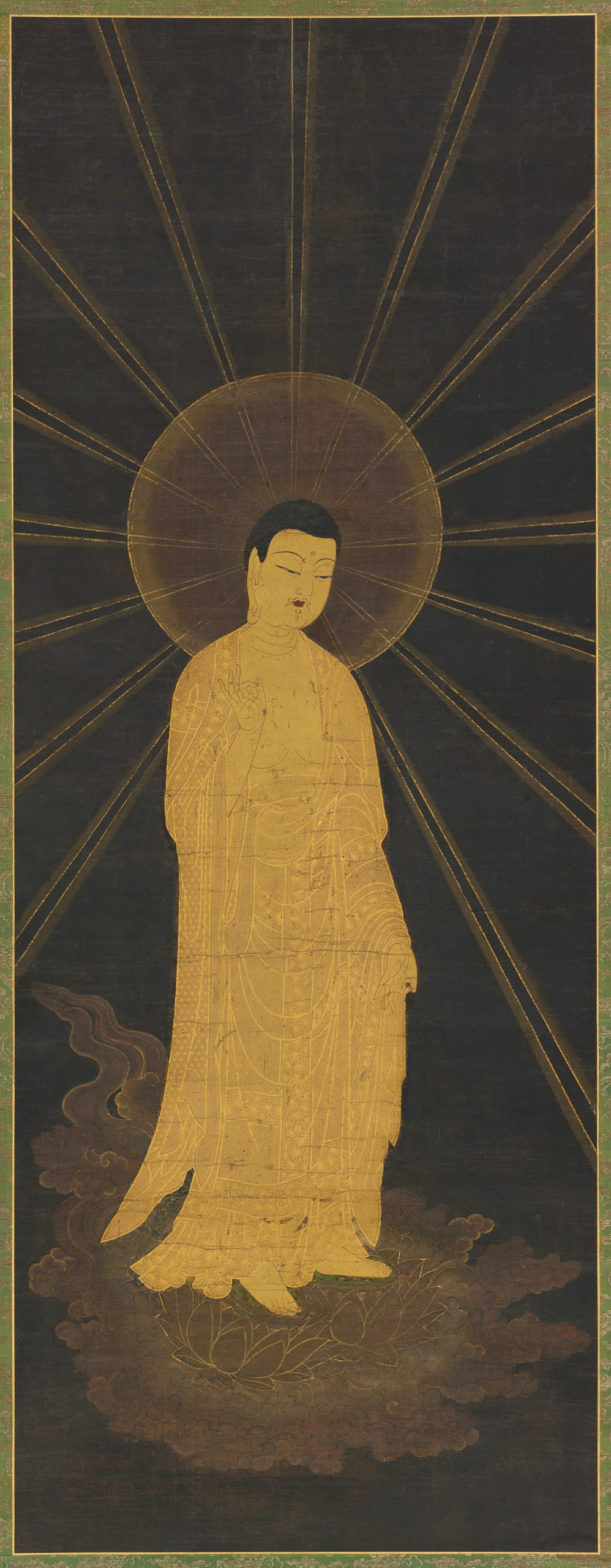
Shakyamuni Buddha introduced the story of Amitabha Buddha in the Infinite Life Sutra. According to the text, in ancient times and possibly in another world, Amitabha Buddha was a monk named Dharmakāra. In some versions of the sutra, Dharmarkāra is described as a former king who, having come into contact with the Buddhist teachings through Buddha Lokeśvararāja, renounced the throne. He then resolved to become a Buddha and thus come into possession of a buddhakṣetra (a world existing in a primordial universe outside space-time, produced by the merit of a buddha) of many perfections. These resolutions are expressed in his forty-eight vows, which outlined the kind of buddhakṣetra Dharmakāra sought to create, the conditions under which beings would be born in that world, and what kind of beings they would be when reborn there.
“When I become Buddha, all sentient beings in the ten worlds who follow the doctrine of Buddha’s recitation, who develop a sincere and true mind, who have the utmost faith and joy, who wish to be born in my land, who are convinced to recite the Buddha’s name with their whole heart (and even just ten recitations of the Buddha’s name), can be born in my land.”
After a long period of practice, Dharmarkāra became a Buddha, known as Amitabha Buddha. The land of Amitabha is called the Pure Land of Ultimate Bliss.
“To the west of our world, beyond the bhakti of the ten billion buddhas, there is a world called Ultimate Bliss. In the Land of Ultimate Bliss lives a Buddha, whose name is Amitabha, who speaks the Dharma. It is called the world of bliss because the people of that Buddha realm do not suffer, but only enjoy bliss.”
— Sakyamuni Buddha presents the Pure Land in the Buddha Sutra on Amitabha
Pure Land Buddhism advocates the practice of reciting the Buddha as the inner cause and aspiring to the Buddha Amitabha as the outer cause, so that the inner and outer aspects are in harmony and one can be reborn in the Western Paradise. The practice of Pure Land Buddhism is simple and easy to carry out, with the fundamental method of mindfulness and the chanting of “Namo Amitabha”, which is applicable to everyone regardless of one’s condition and background.
The main texts of this stream are usually grouped into what are known as the “Five Sutras and One Treatise”, these being: the Sutra of Infinite Life, the Buddha Sutra of the Visualisation of Infinite Life, the Buddha Sutra on Amitabha, the Chapter on Buddha Recitation by the Bodhisattva Daishonin, the Purification of Bodhisattva Desires, and the Treatise on Attaining Rebirth. These sutras were translated into Chinese during the 1st–5th centuries AD by the monks Saṃghavarman, Kalam Yasa and Kumarajiva.
The belief in Maitreya, the Pure Land philosophy, and the practice of “nianfo” (recitation of the Buddha’s name) were already present in ancient Indian Buddhism, but did not form a separate school. With the introduction of Indian Buddhism into China, the Pure Land philosophy was enriched and developed by Chinese Buddhist teachers, leading to the formation of the Pure Land School.
Pure Land Buddhism advocates compassion and peace, emphasises ethics and morality, promotes inner purification, and is easy to practice, making it a convenient and soothing remedy for the hectic modern world. In particular, the transcendental philosophy of life and the life-care system of Pure Land Buddhism are of great significance in enriching the “life issues” of today’s world and improving the quality of life of every believer.